
Designer’s Philosophy · Yang's EA Story
Why WanOne models the enterprise before it generates software
Here I share the thinking behind WanOne: how I understand enterprise architecture, the design choices I believe matter, and how those ideas have developed from my paper into a product.
When My EA Experience Met AI
The idea behind WanOne grew out of many years of Enterprise Architecture work and a question we had been discussing for a long time: if Enterprise Architecture can describe how a business should work and how IT should support it, could that architecture eventually be turned into working systems? That question became even more compelling as AI opened up new possibilities.
Over the past 15 years, much of my work has been in enterprise architecture, business and data modeling, application and data architecture, and large-scale banking transformation. That experience gave me a practical view of how business architecture can connect all the way through to implementation.
Last summer, we began exploring this possibility more seriously. By last fall, those discussions had developed into the paper EA2SysGenAI: A Generative AI for Automated Enterprise System Generation, which helped make the architecture and the overall approach much clearer.
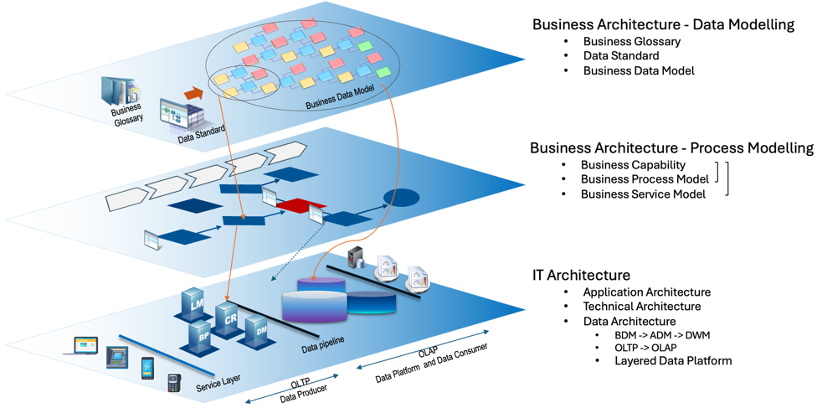
At its core, the framework connects Business Architecture to IT Architecture, so business data, processes, and services are not modeled in isolation but progressively translated into applications, data platforms, and system implementations. The key idea is that Enterprise Architecture can become more than documentation — it can become the structured foundation from which systems are generated.
From there, I started turning the idea into a real product. Business Architecture became the foundation of the metamodel, defining how business data, processes, capabilities, services, and their relationships could be represented in a structured and machine-interpretable form.
The next challenge was how AI should participate in both directions: helping users author and refine the EA model, and interpreting that model to generate software. This went through many iterations, while AI models and development tools were also evolving rapidly and accelerating what became possible.
After continuously refining the metamodel, the architecture, and the generation approach, we are finally able to bring WanOne to life.
01 · Position
WanOne is not starting from code
I want to present some concepts about this WanOne AI product. Eventually we can use these concepts to clarify why enterprises need Enterprise Architecture, and what each layer means. The story should go from outside to inside, step by step.
“Business data defines the destination. Business processes define the journey. Application architecture decides how computer systems will make that journey executable.”
This is the center of the design. WanOne is not trying to generate disconnected screens, random APIs, or isolated database tables. It tries to describe the enterprise first, then let system generation follow the enterprise model.
02 · Business Architecture
Business Architecture existed before information technology
Information systems did not create Business Architecture. They digitized it. An information system usually has a database, a UI, and business logic. Users interact with the database through the UI, but the deeper structure already belongs to the business.
Generalization identifies similar business functions and represents them as a shared higher-level capability. Specialization lets each business area apply its own rules, data, process, and responsibilities. WanOne uses this balance as the starting point before moving into data, process, service, application, and generation.
03 · Business Data Modeling
The Business Data Model is the container and destination of the enterprise
Application data modeling asks how one system should store and process data. Business Data Modeling asks what information the enterprise actually manages, independent of one application’s timing, transaction, performance, or physical database concerns.
WanOne organizes that container into A, B, and C models. A Model defines data concepts. B Model defines subject areas. C Model defines data entities. This is where generalization mostly happens. Specialization usually appears later, in application design, where a specific system implements part of the enterprise model.
The Business Data Model provides a structured representation of the business through its data and relationships. The Application Data Model describes how a software system implements selected parts of that business.
04 · Enterprise reuse
Generalization is powerful, but it is a double-edged sword
From the point of view of each package, duplicated customer logic may be reasonable. Each package was designed to support its business independently. From an enterprise view, however, the same business concept appears in too many places with different meanings, rules, and data structures.
The architect must balance reuse and autonomy. This decision needs business experience, IT experience, data modeling experience, application design experience, and the ability to foresee the consequences. WanOne can help discover patterns, but architectural judgment still matters.
05 · Business Process Modeling
Process is the action that manipulates business data
In WanOne, data is the destination and process is the action that manipulates data. Orders are created, customers are registered, payments are processed, products are delivered, and reports are generated. These actions change the state of enterprise information.
Business Process Modeling gives WanOne the operational structure of the enterprise. It connects business data to business action, and later to generated workflows, screens, services, APIs, validations, and database operations.
06 · Process layers
L0 to L5 move from business landscape to executable step
WanOne divides Business Process Modeling into six layers. L0 is the business domain layer or enterprise landscape. L1 is a more detailed business domain. L2 is the value chain: what the domain plans, executes, monitors, controls, and reports to achieve a business goal.
L3 is generalized capability. For example, Deposit Management should not be duplicated just because there are retail customers, corporate customers, savings accounts, GICs, checking accounts, branches, mobile banking, online banking, or ATMs. Those variations matter, but not at L3.
L4 specializes the L3 capability into specific process scenarios. Some L4 processes need UI because the user or customer interacts with screens to manipulate business data. Other L4 processes are backend processes: a command, event, schedule, or external call starts the work, and the backend performs steps until data is stored and an outcome is produced.
L5 is the executable business specification. It defines what each step does and how that step changes business data. Without this layer, system generation would only know the drawing of a process, not the data behavior required to make it run.
07 · Business Services
Business Services are generated from data plus process
Business Services are not the starting point. They are the result of the Enterprise Architecture. The service boundary often appears where a business domain and a data subject area meet. The domain is the functional view. The B Model subject area is the data view. They are two sides of the same coin.
In IT implementation, this business service may become an API, a backend service, a workflow step, an event handler, a batch process, or something else. That choice does not belong to Business Architecture. It belongs to Application Architecture.
08 · Application Architecture
Application Architecture decides how the business will be implemented
A Business Service describes what the business can do. Application Architecture decides how software will do it. A service pattern may support REST, GraphQL, event, batch, streaming, or internal endpoint styles. It may also run on different runtime engines.
This keeps logical architecture separate from technology choice. The same business capability can be implemented differently as technology, scale, deployment, and integration requirements change.
WanOne derives the Application Data Model from the L5 business steps. If no process, service, input, event, or integration uses a column, then the system has no source to populate it. A large enterprise model may have thousands of entities and attributes, but a single application only needs the part required by its current processes.
09 · Data Architecture
The warehouse is a layered path from raw data to analysis
The staging area receives selected operational data in its raw or near-original form: structured data, semi-structured data, files, APIs, streams, internal sources, and external sources. It is the raw material for enterprise analytics, not the final enterprise view.
EDW integrates data from multiple applications into a consistent enterprise structure. It cleans, validates, standardizes, reconciles, consolidates, and manages history. It supports management reporting, regulatory reporting, risk analysis, finance, and cross-application analytics.
Not every source table goes to the warehouse, and not every EDW table goes to ADW. Data Architecture selects the operational result data that matters for reporting and analysis, then transforms it through staging, EDW, and ADW until it is ready for business consumption.
10 · System Definition
System Definition maps architecture into owned, deployable systems
In WanOne, System Definition organizes frontend applications by actor, back-end services by capability or subject area, operational database schemas, and warehouse groups for SA, EDW, and ADW. It describes how the modeled outputs should be grouped. The business processes to deliver are selected separately as the Generation Run’s business scope; validation and baseline approval establish the reviewed reference for generation. Shared dependencies may be needed beyond the selected processes.
Splitting systems should be an operational decision, not a fashion. Create extra system boundaries when they help with ownership, deployment impact, change isolation, modernization, scalability, or team responsibility. If AI can generate, test, validate, and deploy one coherent system well, then splitting should wait until there is a measurable reason.
WanOne’s goal is not simply to generate code faster. The goal is to make Enterprise Architecture executable: business meaning first, architecture mapping second, simulation and validation next, and then iteratively generate and refine the system before final deployment. We will continue to develop simulation capabilities so that business models, processes, and generated systems can be tested, evaluated, and refined before deployment.
What comes next for WanOne
What we have achieved
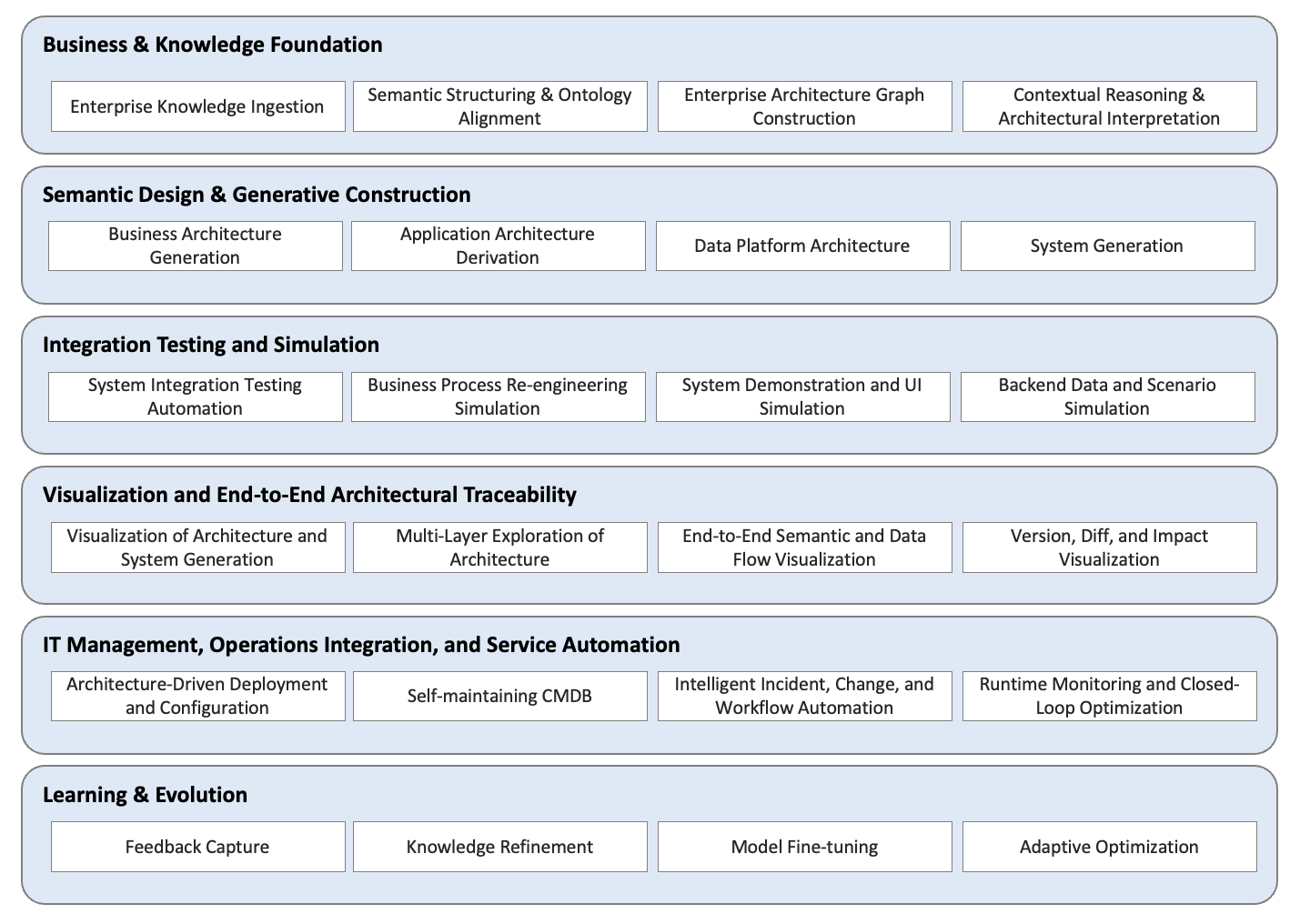
WanOne now brings the core framework into a working product: business data and process modeling, application and data architecture configuration, and system generation from reviewed models. Architecture visualization, data lineage, generation previews, and impact review help connect business intent to its implementation. These provide the foundation for semantic design, generative construction, and architectural traceability.
What we will refine next
Our near-term focus is the first and last two areas in the diagram. We will strengthen the Business & Knowledge Foundation so enterprise knowledge can be structured, aligned, and used more effectively in architectural reasoning. We will deepen IT Management, Operations Integration, and Service Automation, connecting architecture more closely to deployment, configuration, and operational feedback. Through Learning & Evolution, we aim to turn that feedback into better knowledge, models, and future results.
What we will begin developing
Simulation is the next development area: exploring business process changes, demonstrating system and UI behavior, and simulating backend data and scenarios. Alongside integration testing, this will help teams examine how a proposed design behaves before committing to operational change.
The diagram shows the broader product direction. Current capabilities provide a foundation; the refinements and simulation work described here are the next steps.